Insanity defense
The Book of MirrorsThe insanity defense is presented as a court procedure for deciding whether an accused person’s mental condition prevents them from understanding the nature of the charges. Its consequences reach beyond a verdict: an accepted defense can lead to commitment in a forensic mental hospital, while disputed diagnoses and damaged memories shape which accounts of a crime are taken seriously. Through Joseph Wieder’s expert work in the John Tiburon and Derek Simmons cases, the novel distinguishes a legal judgment from a medical diagnosis—and shows how either can become entangled with a defendant’s strategy and a witness’s credibility.
Procedure and Legal Consequences
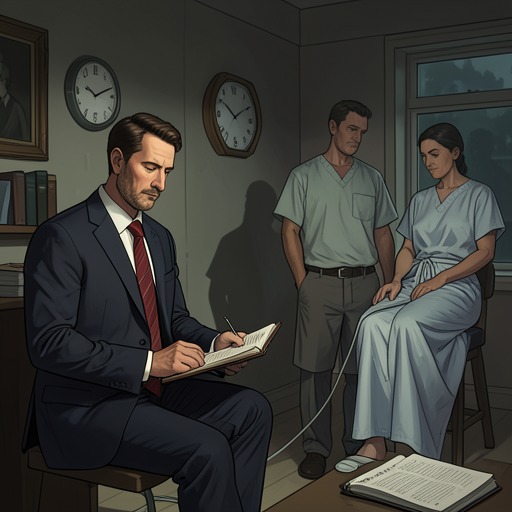
As Laura Baines explains, the procedure described in the novel begins when a defendant’s lawyer argues that the client cannot stand trial by reason of insanity. A team of three experts is assembled to assess the accused’s mental state and prepare a report. The experts do not themselves make the final legal decision: the court considers their report, and the judge rules on whether the defense is justified.
The account links the finding to a specific question: whether mental illness renders the accused incapable of understanding the nature of the charges. If the experts confirm that condition and the court accepts the defense, the person is committed to a forensic mental hospital. The outcome need not be permanent. At a lawyer’s request, a patient may later be transferred to a regular psychiatric hospital or released if a judge rules in the patient’s favor. The procedure therefore governs both the immediate legal response and, potentially, where the accused will live afterward.
This division of responsibility matters in the novel’s cases. Experts offer assessments, but a report must persuade the court; lawyers initiate or contest the claim; and judges authorize commitment or a later change in status. The process turns clinical interpretations into decisions with legal and practical force, while leaving room for disagreement about whether symptoms are genuine and what they mean.
Wieder and the Problem of Feigned Illness
Wieder’s connection to the authorities began roughly seven years before Laura describes his research, when he was teaching at Cornell and was called as an expert witness in a murder case. The accused, John Tiburon, was forty-eight and charged with murdering a neighbour. Tiburon’s attorney claimed that he could not stand trial by reason of insanity. Wieder disagreed with the other two experts: while they considered Tiburon psychotic, diagnosed him with paranoid schizophrenia, and accepted his reported memory loss as real, Wieder argued that he was faking amnesia.
Evidence later supported Wieder’s assessment. Investigators found a journal in which Tiburon had recorded his actions in detail, and it became clear that the neighbour was not his only victim. The journal also showed that Tiburon had collected information about symptoms of psychoses that might support an acquittal. He had prepared to imitate mental illness if he were caught. The episode establishes that an apparent loss of memory can be a deliberate performance, and that a claim of insanity may be used strategically rather than arising from the condition it describes.
The case also gives Wieder’s later opinions institutional weight: he had been right when the other experts were wrong. Afterward, he continued to advise authorities and developed a sustained interest in memory, repression, and amnesia. His experience made him attentive to malingering, but the novel does not present that expertise as a guarantee that every later case could be read with equal certainty. Tiburon’s documented deception provides one model of false symptoms; Simmons’s history presents a much less straightforward problem.
The Simmons Case: Diagnosis, Commitment, and Memory Loss
After Anne’s murder, Derek Simmons was arrested and charged. His attorney seized on the possibility of a mental breakdown and asked that Simmons be found not guilty by reason of insanity. Simmons himself persistently maintained that he was innocent and refused a deal. Wieder examined him repeatedly and concluded that he had a rare dissociative disorder and had been wrongly diagnosed with schizophrenia when young.
In Wieder’s account, the disorder could involve recurring fugue states in which a person loses self-awareness, memory, and a sense of identity. In extreme cases, a person might disappear and later be found living under a new identity without remembering the former life. Applied to Simmons, the diagnosis raised the possibility that he genuinely could not remember what he had done on the night of Anne’s death. Wieder proposed that stress and the altered consciousness of an abrupt transition from sleep to waking might have led him to act as though he were another person. This was an explanation of possible memory failure, not independent proof of what had happened.
Wieder’s report convinced the court, and the judge ordered Simmons committed to Trenton Psychiatric Hospital. With the institution’s and the lawyer’s agreement, Wieder continued therapy, using hypnosis and an experimental mixture of anticonvulsant drugs. After several months, another patient attacked Simmons and inflicted a serious head injury. Simmons then lost his memories completely. He could form and retain new ones, but his earlier memories could not be recovered; Laura identifies this condition as retrograde amnesia.
A year later, at Wieder’s insistence, Simmons was transferred to Marlboro Psychiatric Hospital, where the regime was less strict. Wieder helped him reconstruct a personality, but the apparent return of Derek Simmons was limited: he had the same name and physical appearance, yet could not recall learning to write or becoming an electrician, even though he retained those abilities. His earlier life remained inaccessible. The distinction is consequential for the defense: an inability to remember is not, by itself, an account of what happened, and Simmons’s later amnesia followed a documented hospital attack rather than proving that his earlier claimed fugue state had occurred as Wieder hypothesized.
Credibility, Strategy, and the Limits of the Defense
The investigation repeatedly shows how Simmons’s mental-health history affected the value assigned to his testimony. He later told John Keller that he knew who killed Wieder and had said so at the time, but believed his statement would have been dismissed because he had previously been accused of murder, hospitalized, and medicated. When Simmons alleged that Richard Flynn had killed Wieder and that Laura Baines might have been an accomplice or witness, he offered a specific account, yet investigators could not treat it as conclusive. His illness and amnesia were cited as reasons to doubt him; his version also conflicted with Frank Spoel’s account of who had been present and whether Laura had been there.
The final account of Simmons’s dealings with Wieder sharpens the difference between a defense grounded in illness and a defense that might be deliberately engineered. On the morning Anne was killed, Simmons called Wieder, whose home number he had found while searching Anne’s belongings. He warned that police might make him a scapegoat and threatened to implicate Wieder by exposing the alleged affair with Anne. Simmons also invoked his previous stay in a mental hospital, suggesting that Wieder could help secure a finding of insanity and commitment. The narrative thus presents the defense not only as a response to a diagnosis, but also as something a defendant might try to arrange through leverage over an expert.
Simmons was eventually declared legally insane and committed to Trenton Psychiatric Hospital. Wieder visited under the pretext of professional interest and promised that Simmons would be transferred to Marlboro within three months, but the attack occurred before that move. The resulting amnesia made it possible for Simmons to experience Wieder as a caring doctor without remembering the earlier threat or the circumstances that had brought him into the institution. The novel’s treatment of the defense therefore keeps two questions distinct: what mental condition a person had, and what the person may have done or intended. Expert reports and legal rulings can decide a person’s status, but neither automatically settles the underlying events or restores a reliable witness to the investigation.